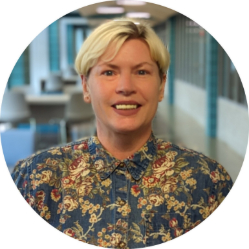
If there's one person at Berkshire Community College who truly understands the value
of a community college education, it's Assistant Professor of Communication Mary Dickman, now in their fourth year at BCC. Mary's roots in education began at Pasco-Hernando
Community College in Florida, their home state.
"Community college is where it all started for me," says Mary, who lived in several
locations in Florida over the years but considers themselves from the Tampa Bay area.
After earning an associate degree, Mary transferred to the University of South Florida
(USF). What started as a plan to earn a degree in psychology turned into three bachelor's
degrees: one in psychology, one in sociology and one in philosophy.
"We have this joke at USF that it stands for 'you stay forever,' Mary says, recalling
that in 2009, the year they planned to graduate, the recession hit and plans changed.
"One of my sociology professors said, 'If you don't want to graduate yet, don't!'"
With multiple degrees in hand, Mary moved to the Pioneer Valley 10 years ago to start
a PhD program at UMass Amherst — but not without challenges along the way.
"I was really interested in going to grad school for social psychology. I applied
to six places and got rejected from all of them," Mary says. "It was disappointing,
but not unexpected. Luckily, I had heard from other graduate students that this happens."
The students advised Mary to reapply the following year.
"I started to realize that many of the things I was interested in were around gender.
So, I applied the next year for master's programs in women's studies at five places
and got accepted into all of them." Opting to stay at USF, Mary says that is where
they learned about communication as a discipline and a field.
"Everything I was interested in — gender and philosophy and psychology and sociology
— could all be studied from the vantage point of communication," Mary says. After
getting accepted to UMass, they relocated here "to start a whole new discipline in
a whole new place."
In 2020, Mary got a job as an adjunct at Bunker Hill Community College. That's when
it clicked: Teaching community college students was what they wanted to do. A couple
years later, Mary took the position at BCC.
I'm really student-centered and interactive. I'm grounded in what's known as communication
pedagogy, in addition to feminist pedagogy. It's a mixture of what I learned from
my master's and PhD programs. Communication isn't just about how to speak or interact
with people. It's more about understanding how communication shapes our relationships,
our communities and our society. I encourage students to think critically about issues
that have to do with power, identity, representation, inequality and privilege, and
to recognize that communication is both used to reinforce and challenge these existing
systems.
Mary says they see the classroom as a space for shared learning.
"I'm focused on students' lived experiences and their perspectives, so I really try
to make the classroom inclusive. We do a lot of discussions and reflective activities
with real-world examples. The goal is to make students more thoughtful, confident,
ethical communicators," they say. In fact, the students are "without a doubt" Mary's
favorite part about teaching at BCC.

Mary Dickman presenting a student award during 2024 Falconer and Department Awards
Ceremony
"I love having intergenerational groups in the classroom, because we get to talk about
how communication changes, how language changes, how we interpret things differently
based on our experiences. These are things you can't get if you're just in classes
with other 18 – 22-year-olds," Mary says. Even more importantly, it's the change they
see in their students that is the most impactful.
"I myself wasn't really confident until my experience at community college, when I
realized, 'Oh, I can do this.' I love seeing that moment with my students," they say.
"Maybe they thought they weren’t smart enough for college, or maybe they’re the first
person in their family to attend college, and then they suddenly realize they can
do this, that it’s not something out of reach. It is truly doable. They discover they’re
more capable than they thought they were."
Mary says that as a proud alum of a community college, they have always had a different
perspective on community college education.
I know first-hand that attending a community college doesn't mean receiving a 'lesser'
education. This isn't just some kind of middle place between high school and 'real
college.' This is real college.
Mary is also a strong proponent of giving community college a try, even for people
who might not think it's for them.
"You don’t have to feel like you’ve got everything figured out before you start. College
is a place for exploration, for discovering your interests and your strengths," they
say. "If you’re not sure where to begin, start talking to someone who’s at college.
Ask questions. Explore programs. Don't be afraid. Be excited about it."